
The West Bengal government's second cabinet meeting is scheduled for May 18, where key decisions on Dearness Allowance (DA), implementation of the Seventh Pay Commission, and other administrative issues are expected to be addressed.

The 7th CPC places the Indian Police Service (and, almost in passing, the Indian Forest Service) on a level with the Indian Administrative Service, leaving the military out in the cold.

Employees of Mumbai's BEST undertaking have launched an indefinite strike, severely impacting public transport and electricity services. The strike, called by a joint action committee, demands budget merger with BMC, settlement of dues, and implementation of the Seventh Pay Commission, among other issues. Despite court orders and MESMA invocation, the strike continues, causing widespread inconvenience to millions of commuters and electricity consumers.

The Brihanmumbai Electric Supply and Transport (BEST) undertaking arranged special bus services for students appearing in the NEET re-examination in Mumbai, deploying 60 buses on 24 routes for approximately 180 trips, despite an ongoing strike by its employees that has paralysed public transport.

The Commission will now have time until December 31 to submit its report.
BEST employees continued their strike in Mumbai for a second day, causing significant disruption to public transport despite appeals from the Maharashtra Transport Minister and the invocation of MESMA. Commuters were forced to rely on alternative, overcrowded transport options, while the striking unions maintained their demands for budget merger, improved pay, and absorption of contractual workers.
Despite BEST employees calling off their indefinite strike, Mumbai's bus services remained significantly below normal on Monday morning, with only 57% of the scheduled fleet operational. Commuters experienced long waits, leading many to seek alternative transport. The strike ended after an agreement with Deputy CM Eknath Shinde, which included interim pay hikes and commitments for future improvements and clearing dues.

The West Bengal cabinet has decided to discontinue assistance-oriented schemes based on religious categorisation for Imams, muezzins and purohits from June. The cabinet also approved the 'Annapurna' scheme of Rs 3,000 monthly support to women from June 1, and granted in-principle consent for their free travel in state-run buses.

The setting up of the Commission, whose recommendations will benefit about 50 lakh (5 million) central government employees, including those in defence and railways, and about 30 lakh (3 million) pensioners, comes ahead of the Assembly elections in 5 states in November and the general elections next year.

Union Minister Sukanta Majumdar criticised West Bengal Chief Minister Mamata Banerjee's dharna and outlined the BJP's promises for the upcoming assembly elections, including job creation, increased financial assistance for women, and proper DA for state government employees.
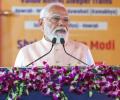
Prime Minister Narendra Modi criticised the ruling TMC in West Bengal, alleging corruption and appeasement politics, while promoting the BJP's development agenda ahead of the assembly elections.

Govt is likely to find it hard to meet deficit target next year.

BJP president Nitin Nabin has accused West Bengal Chief Minister Mamata Banerjee and opposition parties like the Congress for the setback in implementing women's reservation in legislatures.

Analysis of the 7th Pay Commission's recommendations.

The BJP has released its election manifesto for West Bengal, promising a hardline stance on infiltration, financial assistance for women and unemployed youth, and the implementation of the Seventh Pay Commission for state employees.

Kerala, Tamil Nadu and West Bengal have been fiscally stressed for a considerable period of time, and there are no easy ways to mobilise revenues to meet the cost of the promised freebies, particularly in the prevailing difficult economic scenario, points out M Govinda Rao.
The amount constitutes 45 per cent of the railways' total wage bill.

The Pay Commission process is symptomatic of a national crisis within the Indian state.

BJP leader Nitin Nabin accuses the Mamata Banerjee-led TMC government of altering West Bengal's demography by favouring infiltrators and neglecting the rights of the state's residents, promising to rectify the situation if the BJP comes to power.

The recommendations will cost the government Rs 1,02,000 crore.

The total salary and pension bill of the central government, which will also include Railway employees, will go up from estimated Rs 4.33 lakh crore to Rs 5.35 lakh crore during 2016-17
Defence Minister Rajnath Singh has launched a strong attack on West Bengal Chief Minister Mamata Banerjee, accusing her government of appeasement politics, encouraging illegal immigration for votes, and leading the state into misrule and corruption.

Union Home Minister Amit Shah accuses the West Bengal government of openly facilitating infiltration, defends the Special Intensive Revision of voter lists, and asserts BJP's prospects in upcoming elections.

The DMK party in Tamil Nadu has released its manifesto for the upcoming Assembly elections, promising a range of welfare measures focused on women, education, and economic development, including financial assistance and job creation initiatives.

Participants are keenly awaiting the rollovers to the next series ahead of the expiry of June F&O.

Opening up the corner office is fine, but will the government be able to attract talent without giving a market-rate salary?, asks Tamal Bandyopadhyay.

Madhya Pradesh has nearly 750,000 employees who would share the benefit of the pay hike.

The current salary paid by the Delhi government amounts to 17 per cent of the total expenditure.

State governments want the Centre to direct the 14th Finance Commission to compensate states for implementing pay scales, to be recommended by the pay panel.
The pay hike has been made effective from January 1, 2016.
Demands include 5-day banking, PF to be calculated on total salary and allowances, not only on basic
This time, five states, including Tamil Nadu, have requested the Centre to delay the pay hikes.

Home and kitchen appliances, electronic products, apparel and B-segment cars stand to gain.
The Railways is expected to mobilise a substantial chunk of funds through dynamic pricing.

India Inc on said the Seventh Pay Commission set up today for central government employees is likely to lead to additional burden on the exchequer and increase inflation by pushing demand.
Officials cited the example of the Sixth Pay Commission.
State employees in Karnataka will have to wait longer for wage hike.

Top carmakers, including Maruti Suzuki India, Hyundai and Honda, are expecting a spike in their sales following the implementation of 7th Pay Commission recommendations.
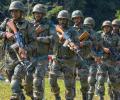
The MSP was introduced to the services recognising their unique service conditions and hardships.

The Centre on Wednesday increased the Dearness Allowance (DA) by 3 percentage points effective from July 1 this year, benefitting more than 1 crore employees and pensioners ahead of the Diwali festival. The Union Cabinet has approved to increase Dearness Allowance (DA) to central government employees and Dearness Relief (DR) to pensioners by three percentage points of the basic pay/pension ahead of Diwali, Union Minister Ashwini Vaishnaw said after the Cabinet meeting.
